
Cerebras Wafer-Scale Engine
From simulation to reality

Part I — The Chip That Became the Model
For decades, computing scaled the same way:
More chips.
More racks.
More networking.
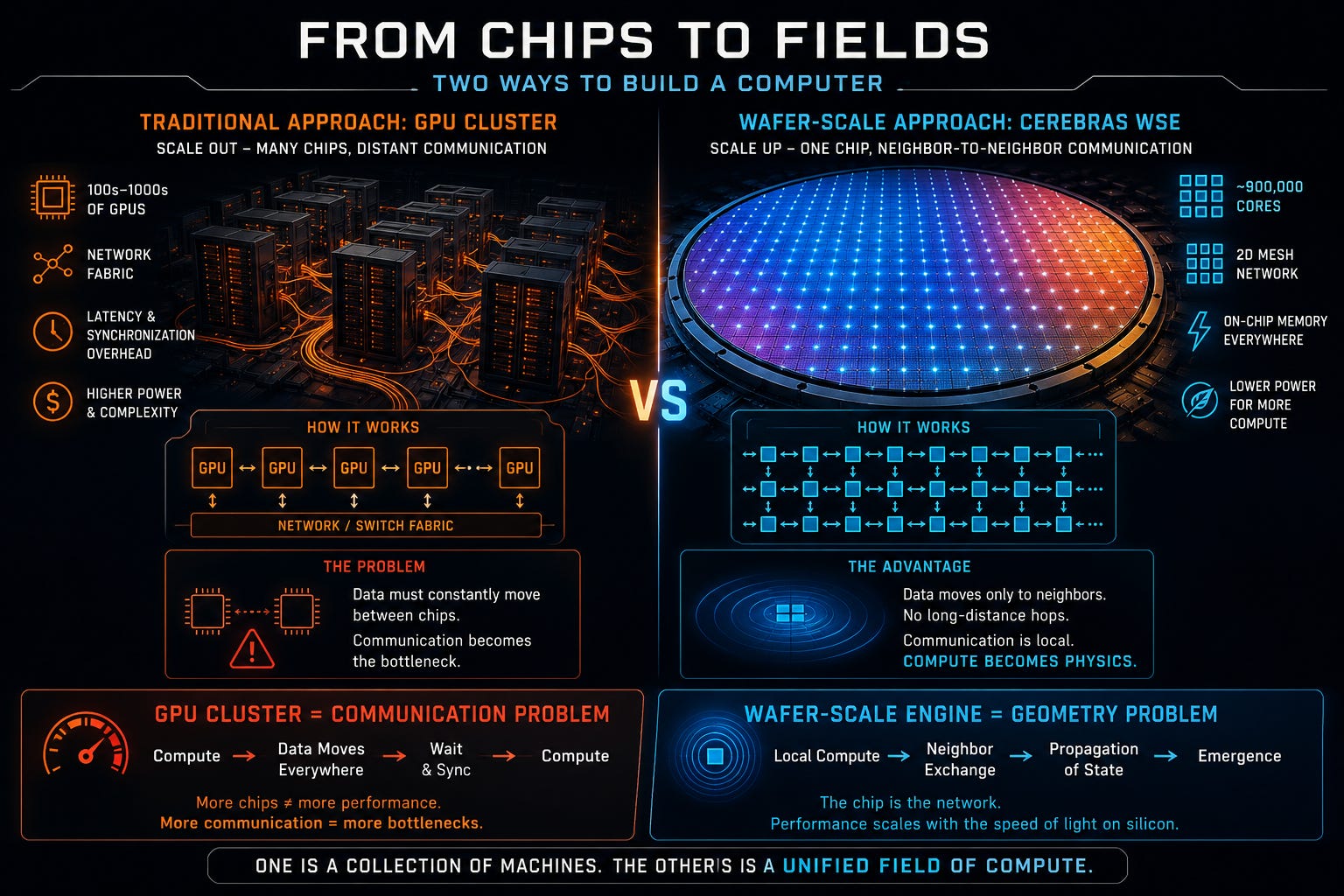
A thousand GPUs pretending to be one machine.
It worked—until it didn’t.
Because the real problem was never compute.
It was communication.
Every time you split a system across machines, you introduce:
latency
synchronization overhead
coordination complexity
You don’t have one computer.
You have a negotiation between computers.
Then Cerebras Systems did something that sounds almost naive:
They stopped cutting the wafer.
Instead of slicing silicon into hundreds of chips…
they asked:
What if the wafer itself is the computer?
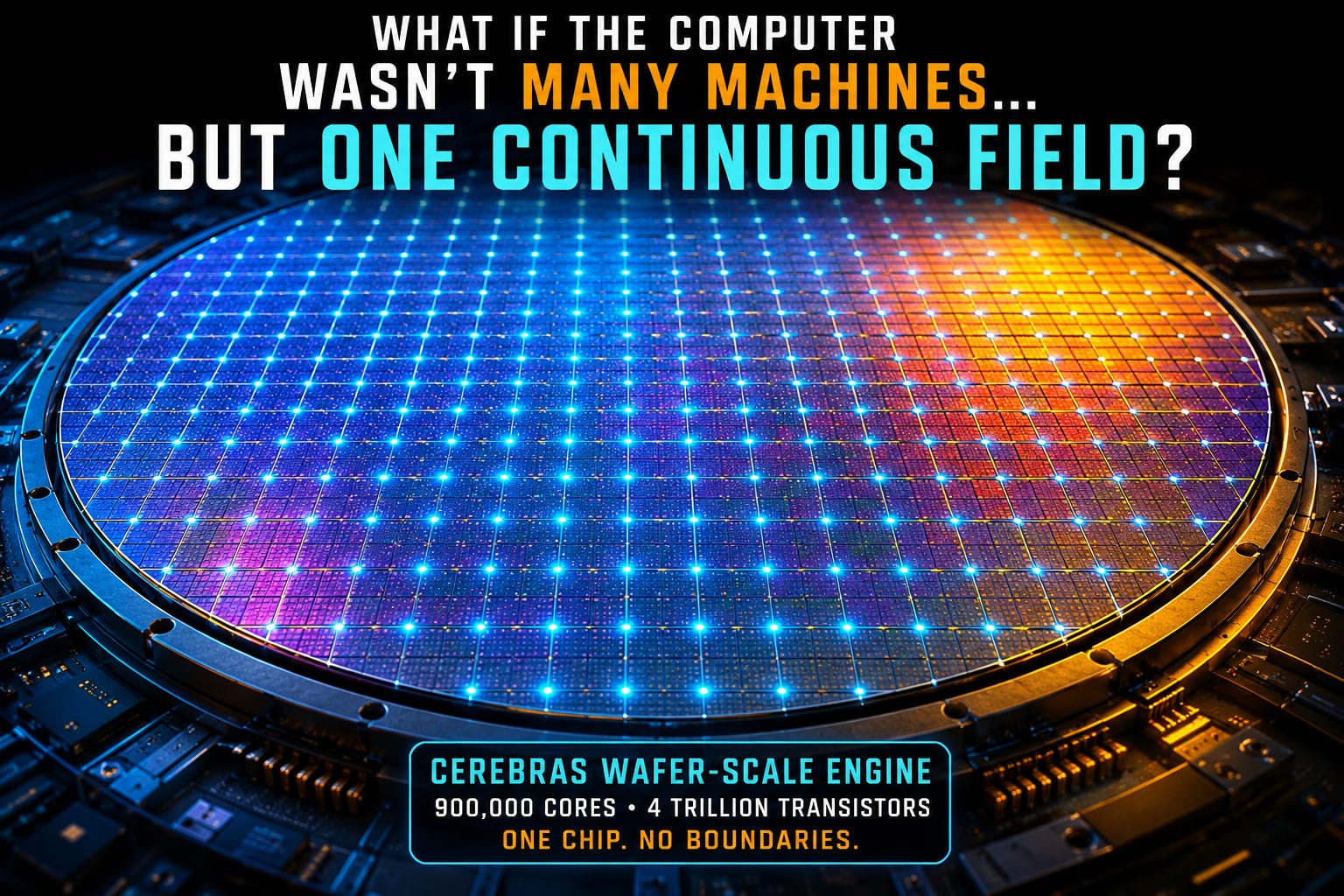
Inside the Cerebras Wafer-Scale Engine, there is no cluster.
No rack of GPUs.
No network fabric trying to stitch things together.
There is only:
~900,000 compute cores
each with local memory
arranged in a continuous 2D grid
connected directly to their neighbors
No “go fetch data from RAM.”
No “send this across the network.”
No “wait for the other node.”
Just:
state moving across space
This flips the problem on its head.
Traditional systems:
computation is easy, communication is hard
Cerebras:
communication disappears into geometry
The distance between two operations isn’t a network hop.
It’s how far apart they are on the wafer.
And that changes everything.
Because now you’re not building a distributed system.
You’re defining a field.
A surface where:
data lives where it is processed
computation happens locally
and results propagate outward
Not as messages…
but as signals moving through a medium
This isn’t a faster GPU.
It’s a different model of reality.
And once you see it…
you start to realize:
we may have spent the last 20 years scaling the wrong abstraction.

Part II — Where Physics Replaces Code
There’s a moment in A New Kind of Science where the ground quietly shifts.
You expect equations.
You expect complexity.
Instead, you get:
a grid
simple rules
time
That’s it.
In the section on fluid flow, Wolfram does something almost offensive to traditional physics.
No Navier–Stokes.
No differential equations.
No global solver.
Just particles on a lattice.
Each step:
particles move
particles collide
particles reflect
And from that—
vortices form
currents stabilize
turbulence emerges

Not because it was programmed.
But because it couldn’t help but happen.
This is the core idea:
Complex behavior doesn’t require complex rules.
It requires enough space for simple rules to interact.
Now look back at Cerebras Systems.
That wafer-scale chip?
It’s not just big.
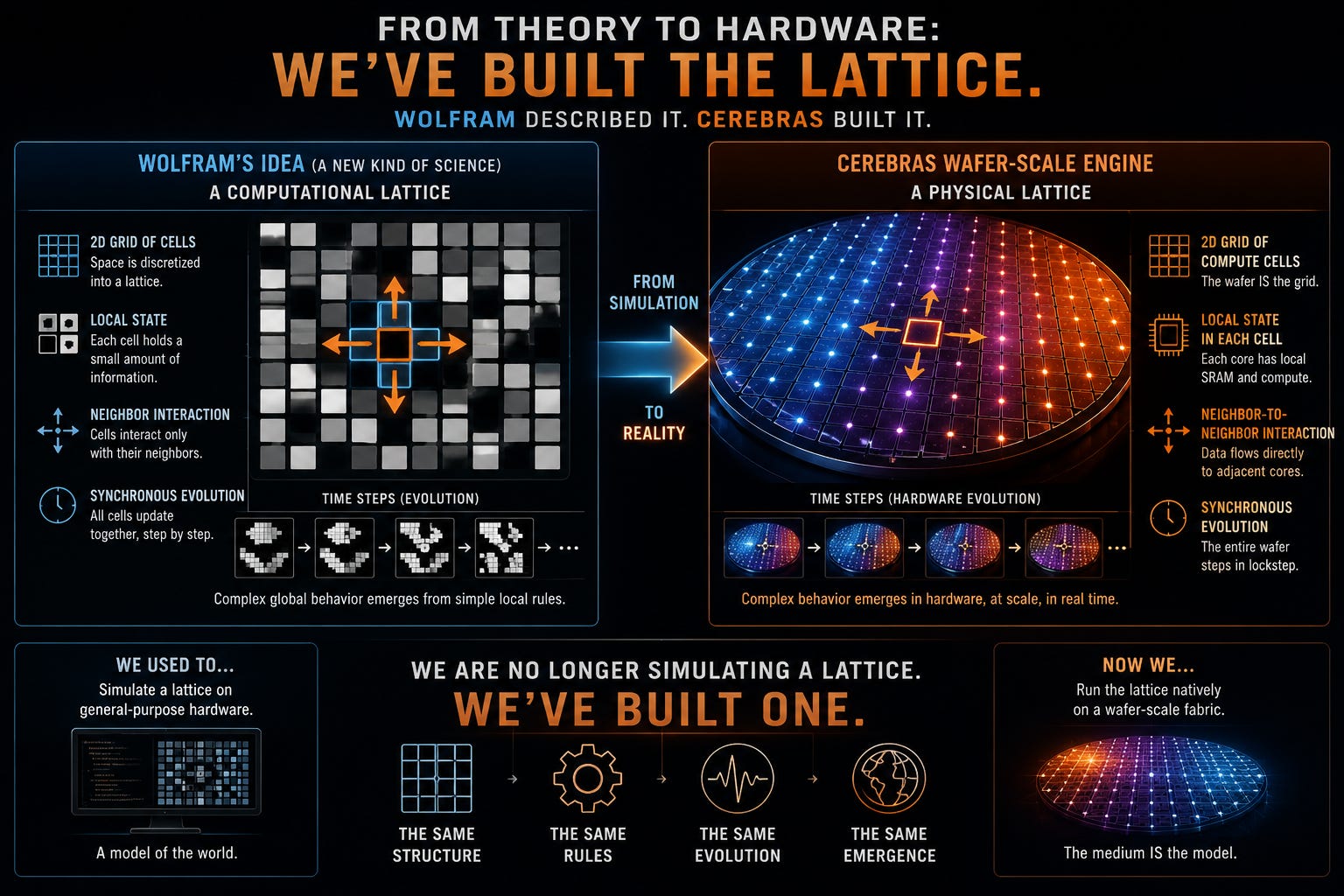
It’s structured like the thing Wolfram was describing.
a 2D grid of compute cells
local state in each cell
neighbor-to-neighbor interaction
synchronous evolution across the field
We are no longer simulating a lattice.
We’ve built one.
This is the inversion.
Traditional computing:
simulate physics using centralized computation
This new model:
let physics-like behavior emerge from distributed local rules
And fluid flow is the perfect example.
You don’t “solve” the flow.
You let it happen.
Each cell:
receives incoming particles
applies a collision rule
passes results to neighbors
No global awareness.
No coordination.
Just:
local decisions, repeated everywhere
What looks like a smooth river…
is actually millions of tiny interactions resolving themselves.
What looks like turbulence…
is a system finding structure under constraint.
And this is where the implications start to get uncomfortable.
Because once you accept this model…
you realize:
fluids aren’t special
physics isn’t special
even intelligence might not be special
They may all be:
emergent patterns in a sufficiently large field of simple rules
Which raises the real question:
If we now have hardware that is that field…
what exactly are we about to discover?


Part III — Code Is No Longer the Bottleneck
Once you see it, you can’t unsee it.
We’ve spent decades optimizing:
compilers
architectures
distributed systems
All to answer the same question:
How do we efficiently compute a global result?
But what if that question is wrong?
Because in the model we’ve just walked through…
There is no global result.
There is only:
state evolving across a field
Let’s go back to the fluid.
In a traditional system:
discretize the domain
derive equations
iterate toward convergence
hope it stabilizes
You’re searching for the answer.
Slowly.
Expensively.
But in a field-based system—like the one implied by the Cerebras Wafer-Scale Engine—
you don’t search.
You instantiate.
Each cell:
holds local state
applies a rule
passes information forward
And the “solution”…
is simply the state the system becomes
Code Sample (Minimal Field Computation)
Here’s what that looks like when stripped down:
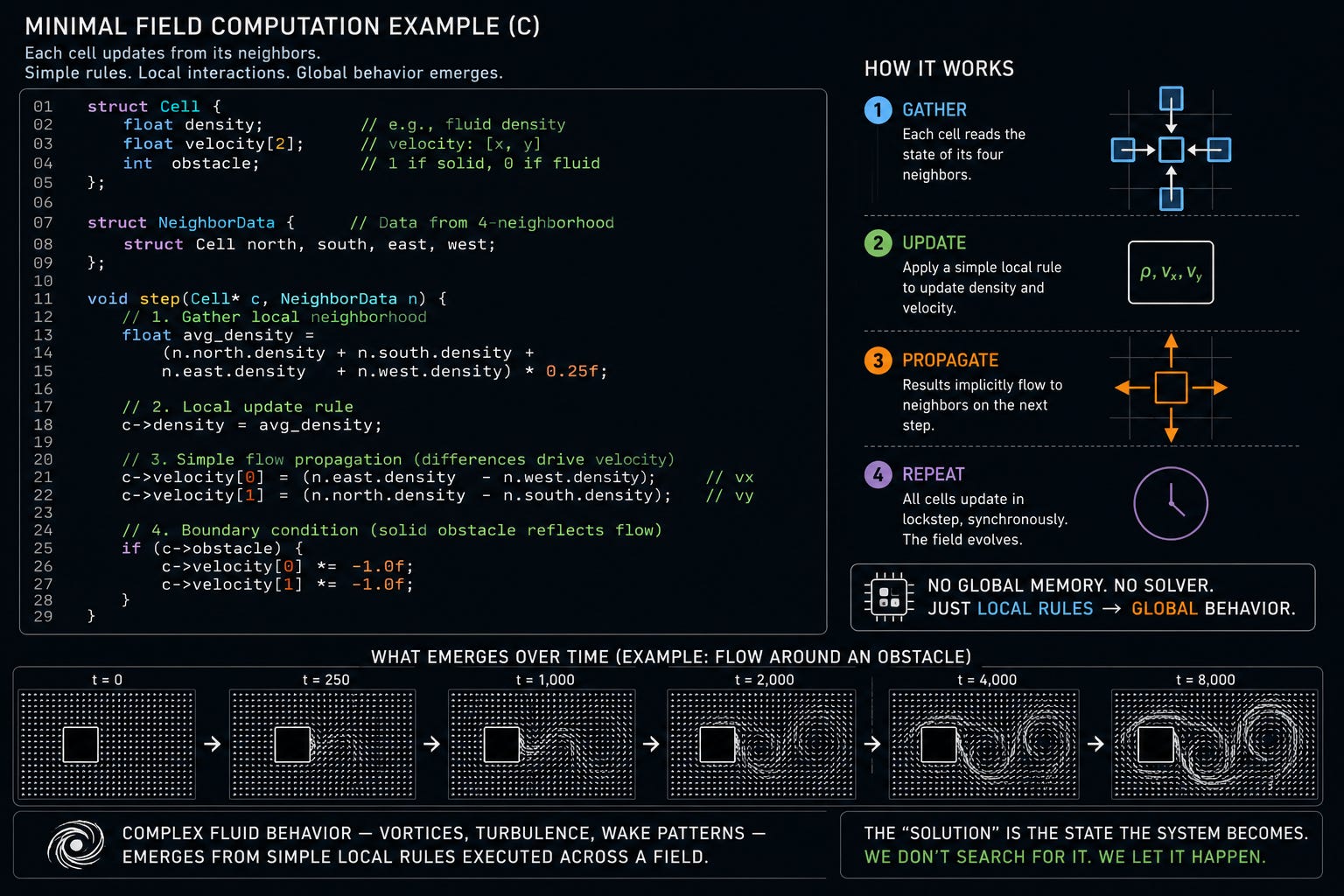
No solver.
No matrix inversion.
No global memory access.
Just:
local rule → global behavior
Synthetic Output (What Emerges)
Run this across a large enough field and you’ll see:
smooth flow regions
boundary layers
vortex shedding
turbulence patterns
Not because you programmed “turbulence”…
but because:
the system had no other choice
Applications — Where This Goes Next
This isn’t just a better way to simulate fluids.
It’s a different way to think about computation entirely.
1. Real-Time Physical Systems
airflow over vehicles (instant feedback)
energy systems / plasma dynamics
weather modeling without supercomputer clusters
2. Spatial AI (Post-Transformer?)
Current AI:
tokens → attention → output
Field-based AI:
state → propagation → emergence
Imagine models that:
live in space
evolve continuously
don’t “predict”—they stabilize
3. Deterministic Distributed Systems
This is where it gets interesting for scale.
Instead of:
nodes
messages
consensus
You get:
spatial structure
propagation rules
natural ordering
Time becomes:
distance traveled across the field
4. A New Primitive
We’ve been treating:
compute
memory
communication
as separate layers.
This architecture collapses them into one:
a unified computational medium
The Shift
We used to:
> simulate systems on computers
Now we can:
> build computers that are systems
And that changes the question from:
> How do we compute the answer?
to:
> What kind of system do we want to exist?
Because once computation becomes a field…
you’re no longer programming outcomes.
You’re designing realities.
