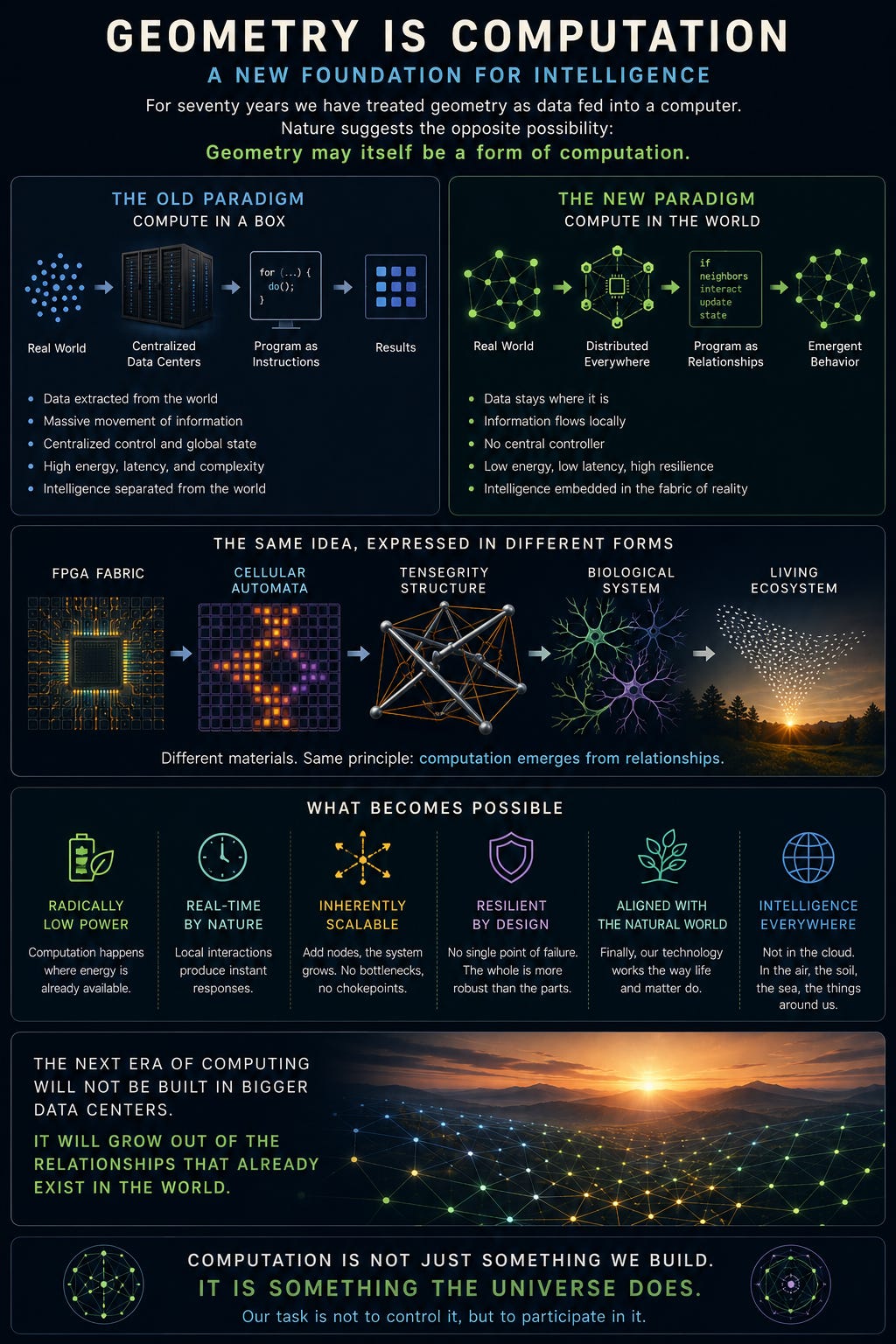
Geometry is Computation
The cost of ignoring space

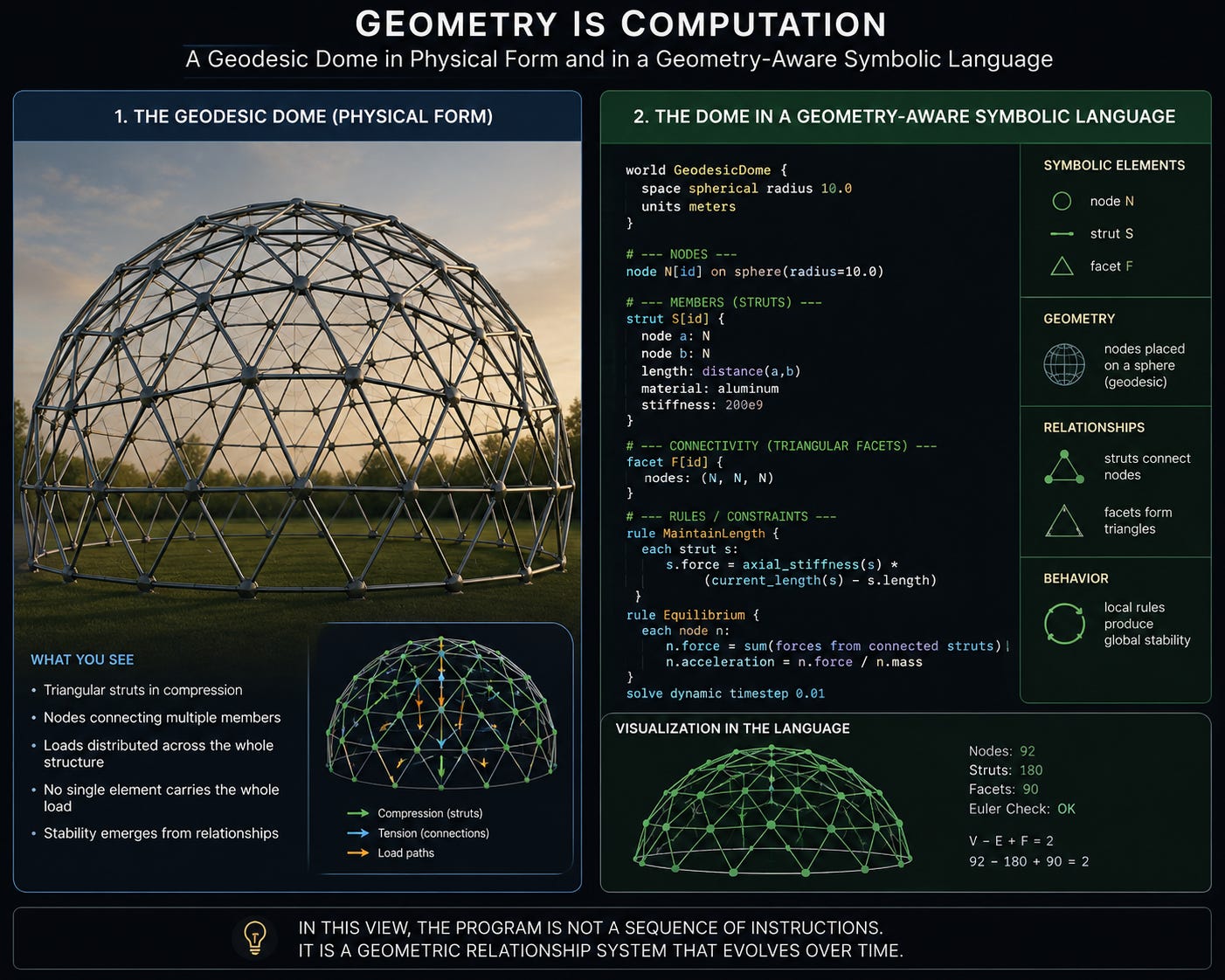

Associated Github Project - https://github.com/taguniversal/matterscript
Part I — Computation Lost Its Shape
Modern programming languages descend from a peculiar lineage.
Not from biology.
Not from architecture.
Not from physics.
Not even from nature.
They descend from bookkeeping.
The earliest computers were built to calculate artillery tables, process payrolls, manage inventories, and balance accounts. The languages that evolved around them inherited that worldview. A program became a sequence of instructions. A list of operations. A series of symbolic manipulations performed one after another.
input
↓
process
↓
output
For seventy years this model has been spectacularly successful.
Yet when we look at the natural world, we find almost no examples of computation occurring this way.
A tree does not execute instructions.
A cell does not call functions.
A geodesic dome does not consult a central processor to determine whether it should remain standing.
Instead, stability emerges from relationships.
The dome exists because every strut knows its neighbors.
The cell exists because every molecule interacts with nearby molecules.
A flock exists because each bird responds to the birds around it.
In each case, geometry is not an input to the computation.
Geometry is the computation.
This observation sits at the heart of Stephen Wolfram's New Kind of Science. A cellular automaton can produce astonishingly complex behavior using nothing more than simple local rules applied repeatedly to neighboring cells. There is no central intelligence. No master plan. No global state. The structure itself performs the computation.
And yet our programming languages largely ignore this fact.
We describe geometry as data.
We describe relationships as pointers.
We describe space as coordinates.
Then we feed those descriptions into a machine that knows nothing about the spatial reality they represent.
What if we reversed the equation?
What if space, adjacency, tension, distance, and connectivity were first-class concepts in a programming language?
What if the program was not a sequence of instructions at all?
What if the program was a shape?
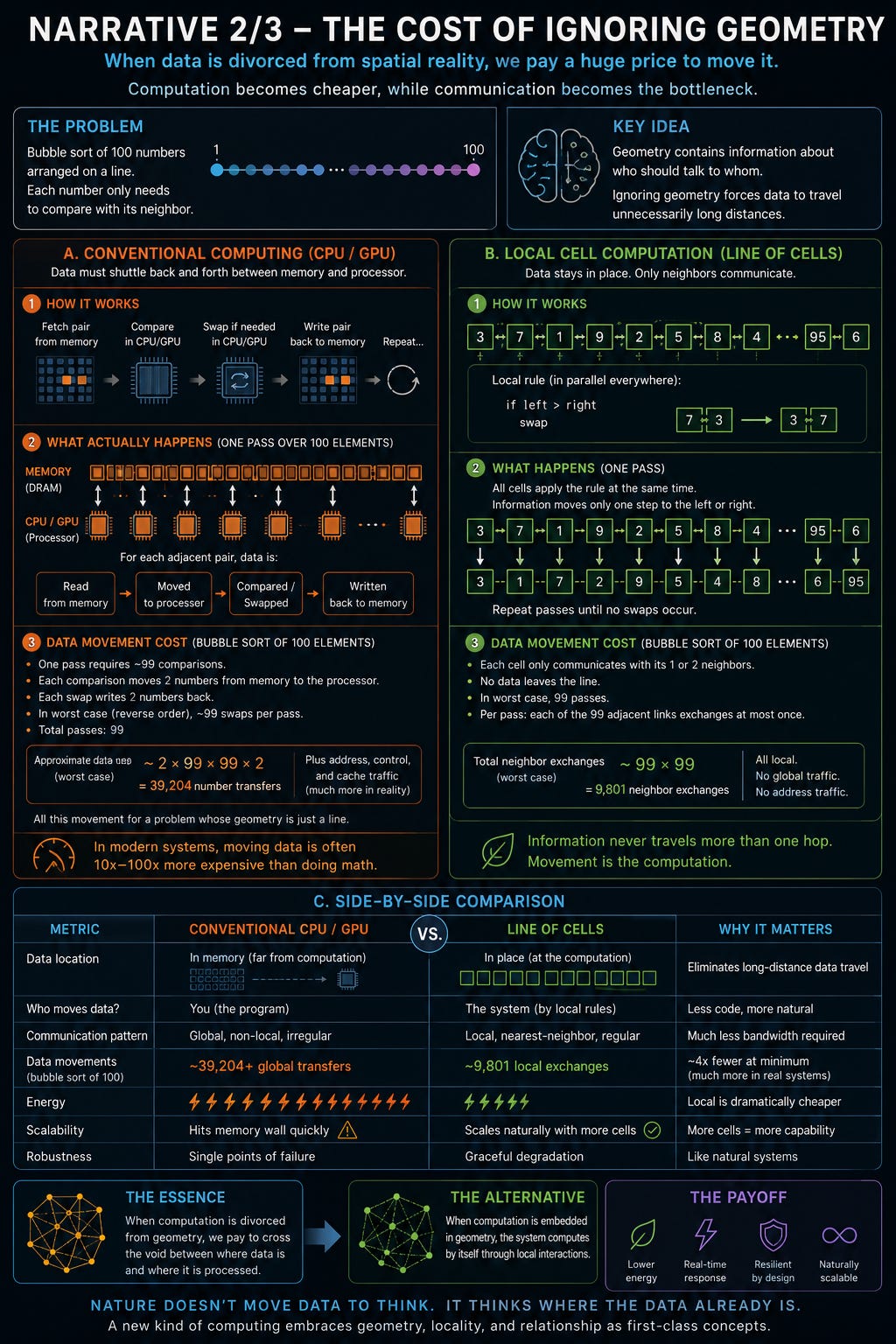
Part II — The Cost of Ignoring Geometry
One of the strangest assumptions in modern computing is that computation and geometry can be separated.
A conventional processor treats memory as a giant warehouse of symbols. Data is fetched from memory, transported across buses, loaded into registers, manipulated, and then written back out again.
The machine spends an astonishing amount of effort simply moving information around.
In modern AI systems, this problem has become so severe that memory bandwidth is often more valuable than the arithmetic itself. Entire trillion-dollar industries are being built around the simple fact that moving data is expensive.
But what if the computation already lived where the data resides?
Imagine one hundred numbers arranged in a line.
A traditional bubble sort running on a CPU behaves something like this:
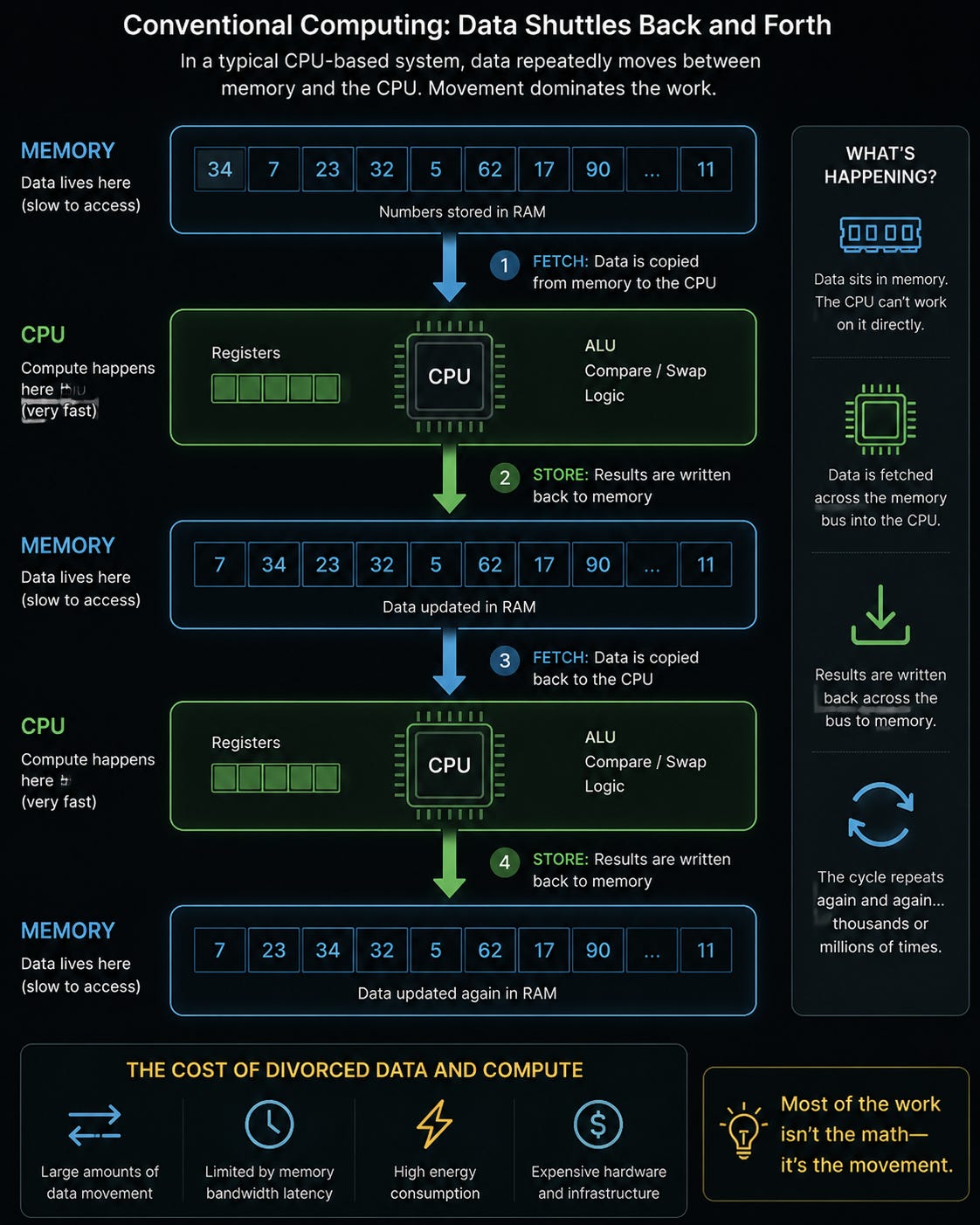
The processor repeatedly fetches values, compares them, swaps them, and writes them back. The same pieces of information may travel across the memory hierarchy dozens or hundreds of times before the sort is complete.
The geometry of the problem—a line of numbers—is completely invisible to the machine.
Now imagine the same problem represented as a line of cells:
3 7 1 9 2 5 8 4
Each cell can only communicate with its immediate neighbors.
A simple local rule says:
if left > right
swap
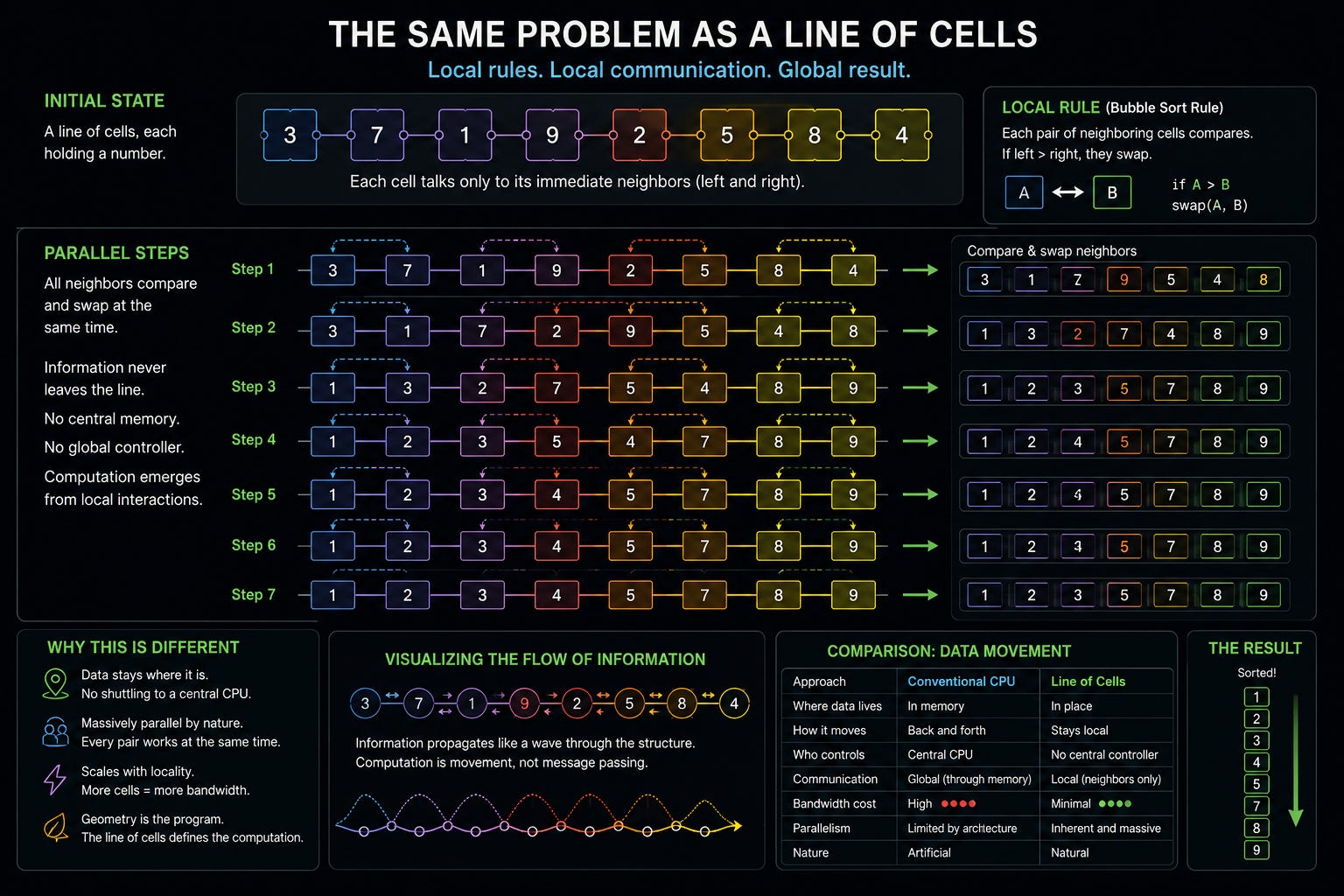
The sort is no longer executed by a central processor.
The sort emerges from local interactions.
Information never leaves the line.
No global memory fetches.
No central scheduler.
No instruction stream.
The geometry performs the computation.
This is exactly the kind of behavior that appears in cellular automata, reaction-diffusion systems, biological tissues, and many natural systems. Complex global behavior emerges from simple local relationships.
In a conventional computer, moving the data is often more expensive than understanding the data.
In a geometry-aware system, movement and computation become the same thing.
A disturbance propagating through a tensegrity structure.
A pressure wave moving through water.
A signal traveling across a neural network.
A sort rippling through a line of cells.
All of these are examples of computation encoded directly into spatial relationships.
The machine does not execute a program describing the geometry.
The geometry itself becomes the program.
And once that idea is accepted, a provocative question emerges:
If nature computes through relationships, why do our programming languages insist on describing everything as instructions?
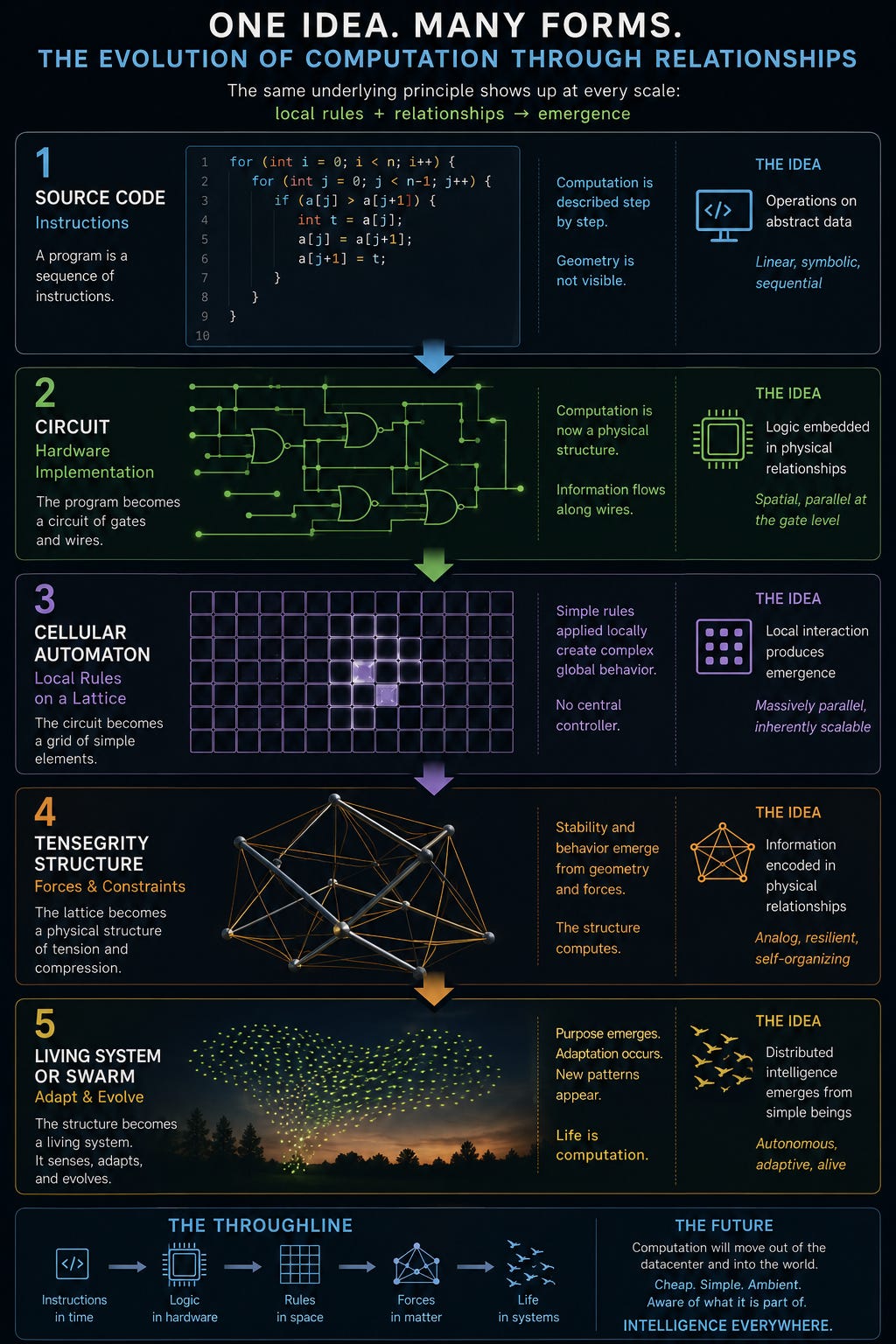
Part III— When Computation Lives Inside the World
For most of the computer age, we have imagined intelligence as something that lives in a box.
The box became a mainframe.
The mainframe became a server.
The server became a cloud.
The cloud became a hyperscale AI datacenter consuming gigawatts of power.
Every generation concentrated more computation into fewer locations.
The assumption was simple:
Intelligence belongs in the center.
But nature rarely works this way.
A tree does not ask a central processor whether it should grow toward sunlight.
A flock does not upload its state to a datacenter before changing direction.
A tensegrity structure does not consult a control tower before responding to a force.
The intelligence is already embedded within the system itself.
Every component understands its local relationships.
Every component participates in the computation.
Every component knows what it is part of.
Perhaps the future of computing is not larger datacenters.
Perhaps the future is ambient computation.
Tiny pieces of logic distributed everywhere.
Cheap.
Simple.
Local.
Instead of moving vast amounts of information to a central intelligence, computation occurs where the information already exists.
A sensor does not report to the cloud for permission to react.
A robot does not wait for a distant model to understand its environment.
A structure does not upload itself for analysis before adapting to stress.
The computation emerges directly from the geometry of the system.
In such a world, a programming language might describe relationships instead of instructions:
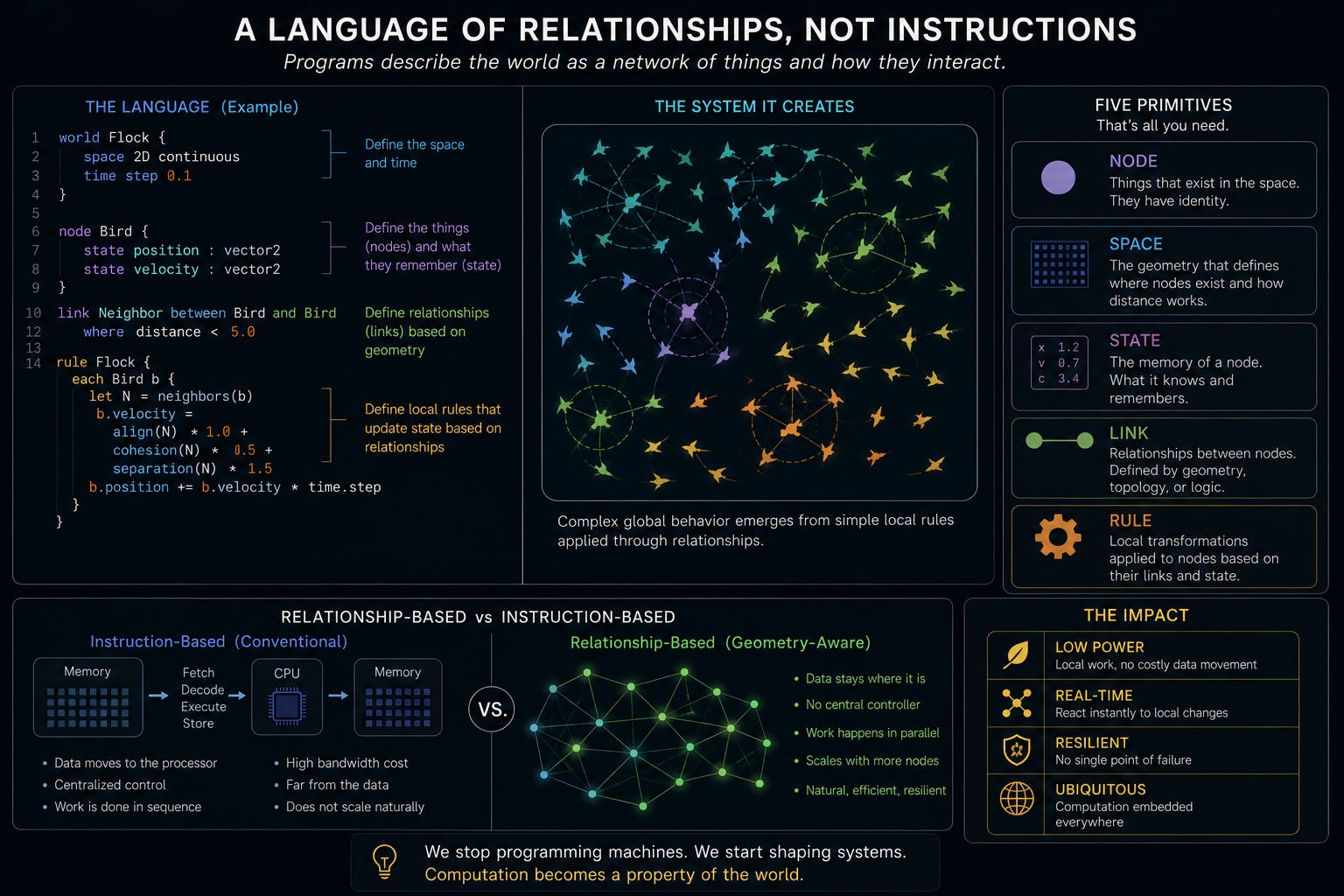
The resulting programs would not resemble software in the traditional sense.
They would resemble living systems.
Swarms.
Tissues.
Tensegrity structures.
Cellular automata.
The distinction between memory, communication, and computation would begin to disappear.
Information would live where it is needed.
Computation would occur where it is generated.
Geometry would become the execution engine.
This is not merely a different way to write software.
It is a different way to think about intelligence itself.
For seventy years we have built machines that treat the world as something to be observed from a distance.
Perhaps the next generation of systems will compute the way nature computes:
Not from the center.
But from everywhere at once.